

Main topic
Underground hydrogen storage
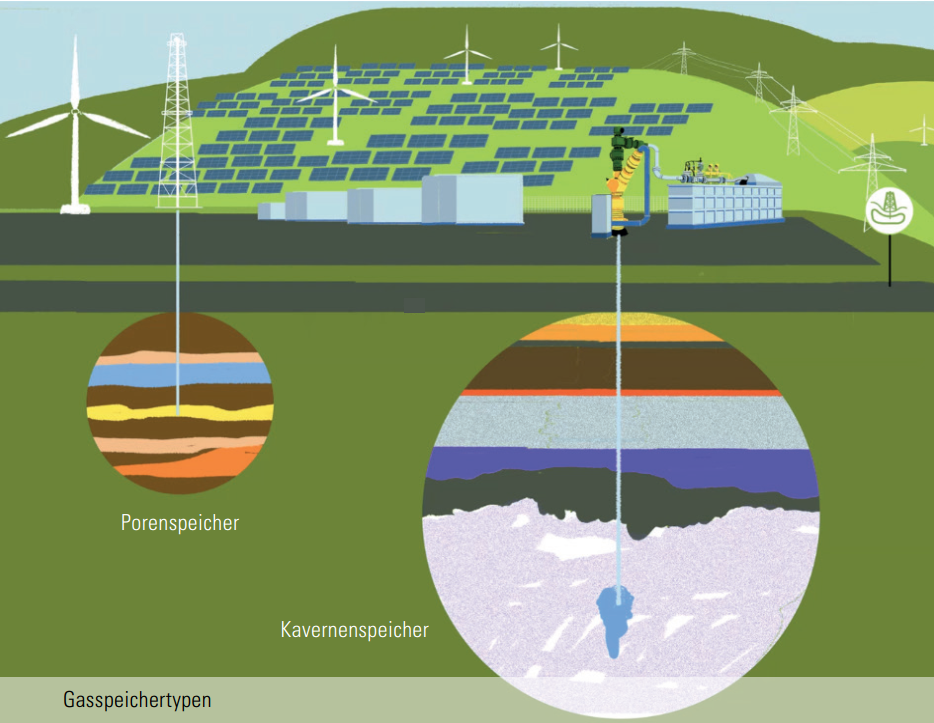
Underground hydrogen storage (UHS) refers to the storage of hydrogen in geological storage structures such as caverns or porous-media storage facilities. It enables large amounts of energy to be stored seasonally or in support of the energy system and allows hydrogen networks, producers and consumers to be connected flexibly.
As renewable energy sources become increasingly integrated into the energy supply system, storing hydrogen produced from fluctuating wind and solar power is becoming a key system requirement. Underground gas storage facilities (UGS) can play an important role in this context, as existing storage infrastructure could be adapted for hydrogen or hydrogen blends in the future.
The DBI Group supports you in assessing existing underground gas storage facilities and converting them to hydrogen. Together with you, we develop a strategy tailored to your specific requirements.
Image caption/alternative text: Schematic representation of porous-media and cavern storage facilities for hydrogen within an example energy system featuring wind and solar power generation.
Services for converting natural gas-UGS to hydrogen (UHS)
- Evaluation of hydrogen storage capacities in porous-media and cavern storage facilities
- Assessment of the current condition and hydrogen tolerance of above-ground and subsurface UGS facilities
- Material assessments and analysis of changes to process parameters
- Conversion concept, including measures, schedule and cost plan
- Economic feasibility assessments
Reservoir Modelling for Underground Hydrogen Storage
Underground hydrogen storage (UHS) requires tailored modelling approaches that account for hydrogen’s specific flow behaviour and interaction mechanisms beyond those encountered in conventional natural gas storage.
We support hydrogen storage projects in salt caverns, depleted gas fields and aquifers – from the conceptual and feasibility phases through to field implementation. Dynamic modelling is performed using tNavigator, enabling short turnaround times and an integrated workflow for large-scale compositional models.
Biomethanation Projects in Porous Media: Bio-UGS, UMAS
Hydrogen Storage Projects:
Porous Media: H2-PoreConv, HENRI, Kirchheilingen
Caverns: H2_UGS, H2-StoreFlex
Modelling supports the evaluation of the following aspects:
- Working and cushion gas volumes
- Loss mechanisms and recovery efficiency
- Hydrogen purity and compositional changes over time
- Pressure limits and reservoir management strategies
- Long-term storage performance and technical feasibility
Modelling of Hydrogen Storage in Salt Caverns
Salt caverns are typically modelled as closed, fixed-volume storage systems with strong coupling between thermodynamic, hydraulic, and geomechanical processes.
Key modelling aspects include:
- Assessment of long-term cyclic pressure and temperature behaviour under reservoir stability and integrity margins
- Evaluation of cavern leaching and geometry development
- Analysis of salt behaviour under in-situ stress conditions (e.g. creep, convergence, and subsidence)
- Evaluation of mixing between cushion gas and working gas, including compositional effects
- Assessment of thermal effects during injection and withdrawal cycles (Joule–Thomson cooling/heating)
- Estimation of gas losses (e.g. diffusion, leakage pathways, operational losses)
- Operational optimisation of injection–withdrawal cycles and deliverability
- Assessment of potential microbial activity (typically limited in salt caverns, but considered where relevant)
- Evaluation of abandonment and long-term sealing performance
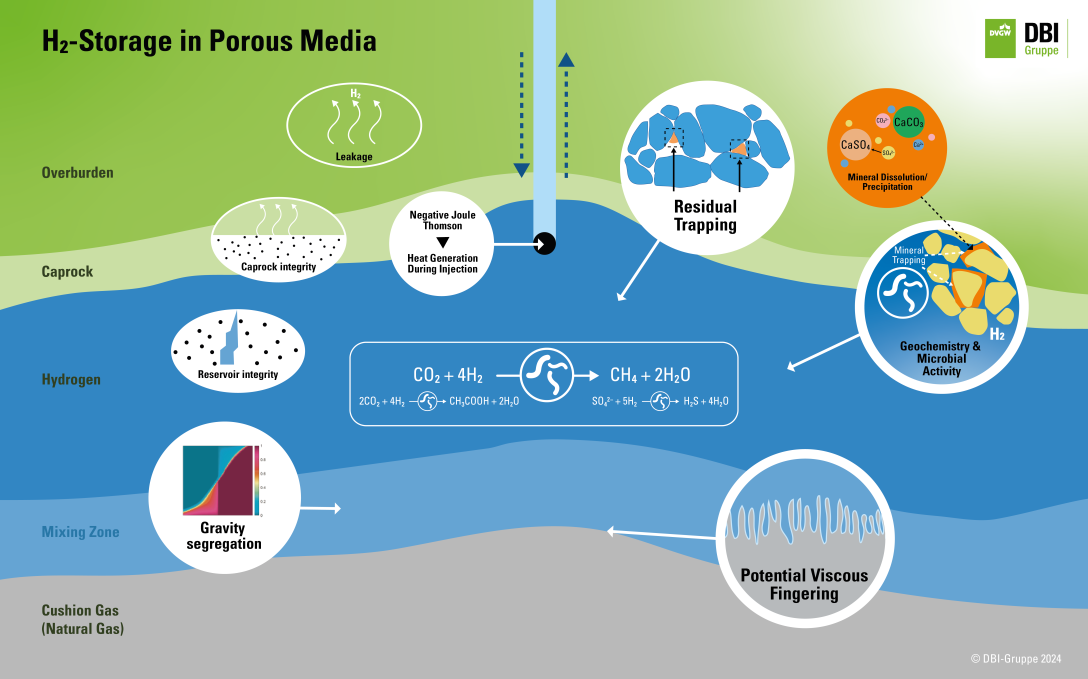
Modelling of Hydrogen Storage in Porous Media
Pore storage is modelled as a dynamic pressure‑driven flow system where reservoir heterogeneity, connectivity, and boundary conditions strongly control storage performance and gas recovery
Key processes addressed in modelling include:
- Gravity segregation and vertical migration of the hydrogen plume
- Development of mixing zones between hydrogen and cushion gas
- Residual trapping and associated hydrogen losses
- Viscous fingering and flow instabilities due to mobility contrasts
- Potential geochemical reactions leading to mineralogical changes, which may cause pore plugging and alterations in porosity and permeability
- Microbial interactions affecting hydrogen consumption and hydrogen purity in production streams, including sulfate reduction (H₂S), acetogenesis, and methanogenesis, potentially resulting in undesired by-products
- Evaluation of the impact of trapping mechanisms on hydrogen recovery efficiency
- Influence of cyclic injection–withdrawal operations on pressure evolution and fluid reservoir behaviour
System integration
Integrating Underground Storage Facilities into the Energy Infrastructure
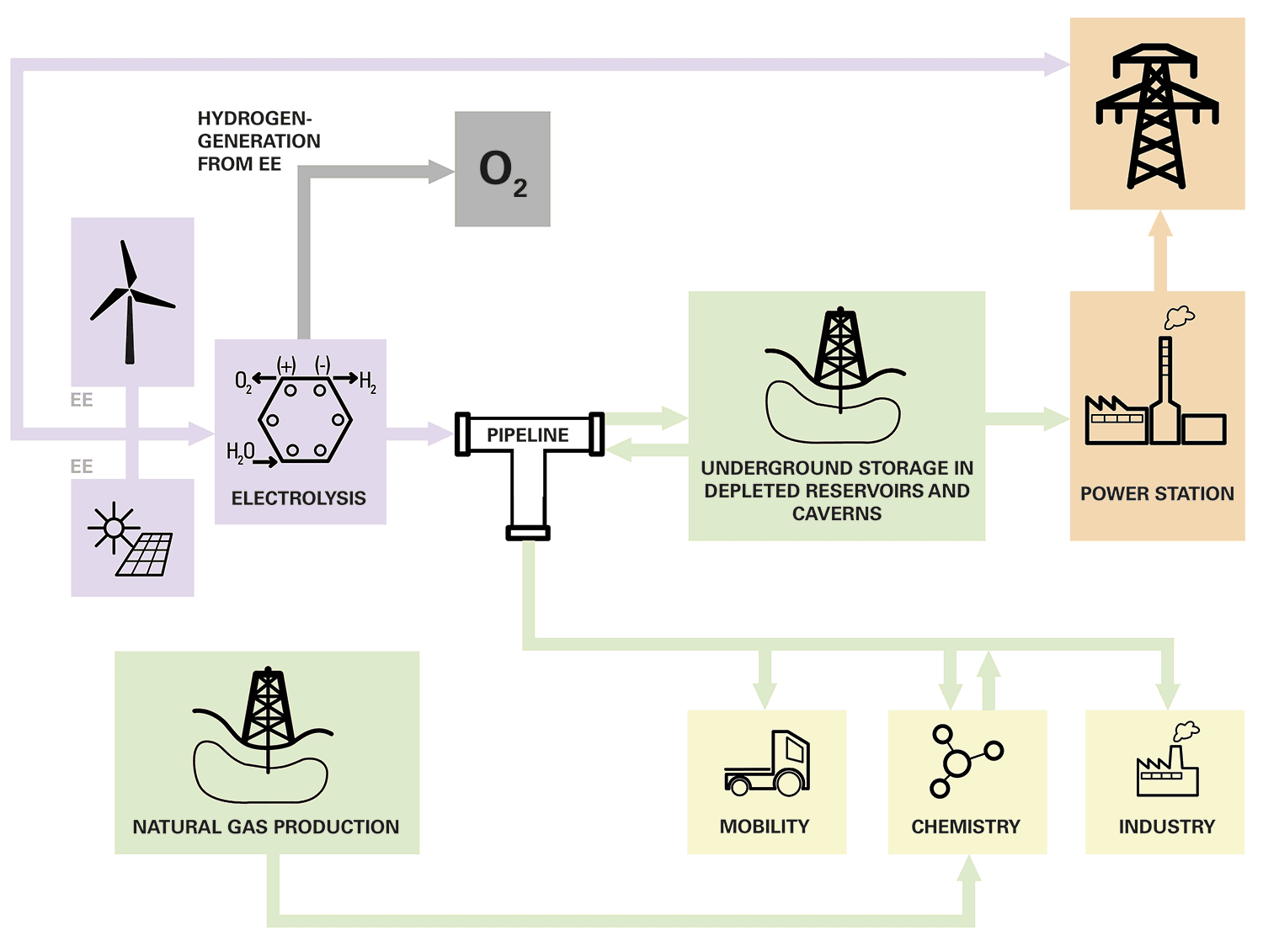
Our solutions follow an integrated approach that considers not only underground gas storage facilities themselves but also their integration into the wider energy infrastructure. This enables us to address issues throughout the value chain of gaseous energy supply.
- Integration of UGS into the gas supply system at the transportation and distribution network level
- Analysis of storage requirements for various media
- Analysis of the required UGS infrastructure and planning for its development
- Optimization of UGS in coordination with grids, producers, and consumers as well as the need for gas treatment
Training
We offer training courses on various aspects of underground hydrogen storage for different target groups such as management, engineers, technicians, and beginners. Training programs and materials can be tailored to individual needs and inquiries.
- The role of hydrogen in the sustainable energy supply system: potential and possibilities
- Properties and characteristics of hydrogen
- UGS infrastructure and its role in a hydrogen system
- Storage capacities: Changes in volumes and energy capacity
- Storage methods
- Impact of hydrogen (mixing) on underground and surface facilities
- Measures to increase the H2 tolerance of UGS, material suitability
- Health Safety Environment and Ex-Zones
Der gesamte Prozess der geothermalen Energieerzeugung kann durch die entwickelte Methodik geplant, optimiert und überwacht werden. Er ist flexibel und standortspezifisch einsetzbar.
Your contact to us

The DBI Newsletter.
Receive regular updates from the DBI, tailored to your personal interests.